


It’s time to bring back Dartmoor’s lost rainforests


Campaigner, author and Dartmoor Nature Alliance core group member Guy Shrubsole describes why it's now time to bring back Dartmoor's lost Rainforests.
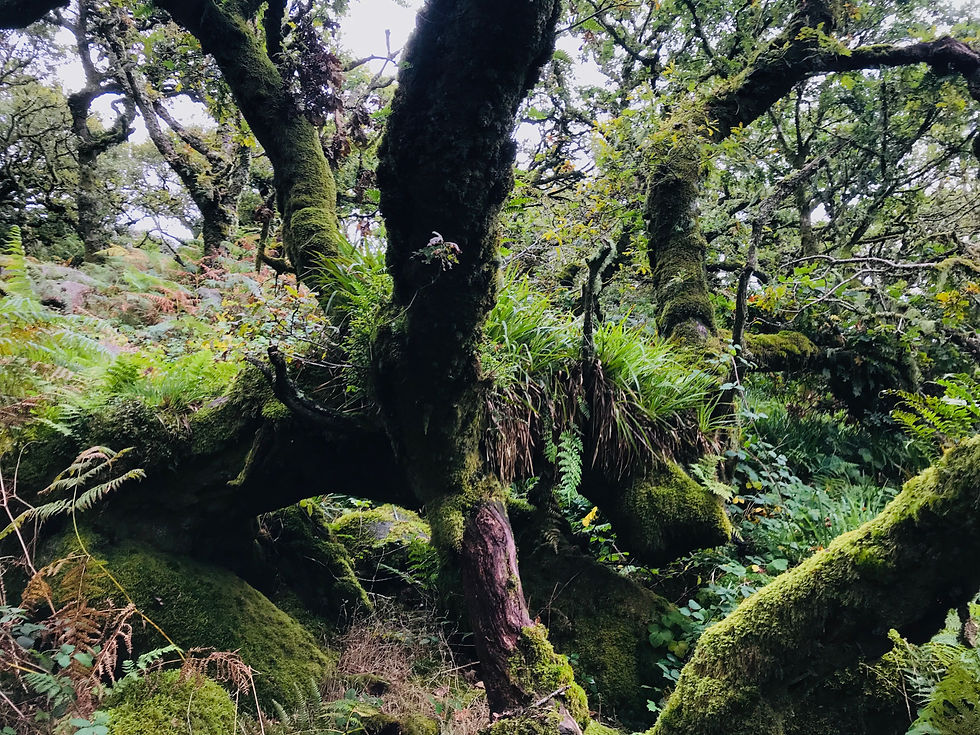
Raindrops bead along a gnarled branch of oak, covered in verdant moss that’s as thick as deep-pile carpet. A downpour has drenched you to the skin, but you’re too enthralled to care: the tree in front of you is draped with grey-green lichens, more lustrous than Gandalf’s beard. A crack in the gunmetal clouds causes sunlight to flash through the acid-green ferns that grow on the tree, illuminating them like a stained-glass window.
It’s a scene familiar to anyone who’s explored one of Dartmoor’s glorious temperate rainforests. But perhaps we don’t always realise how rare and special these places are. Temperate rainforest is an ecosystem that covers less than 1% of the planet’s surface, twinning Dartmoor with far-flung places like the Pacific north-west coast of America and the fern-filled valleys of New Zealand.
Temperate rainforest is also far rarer than it should be – because we humans have destroyed so much of it. On the central Dartmoor commons, just three rainforest fragments remain: the upland oakwoods of Wistman’s Wood, Black Tor Copse and Piles Copse. These tiny islands of wildlife, each a handful of acres in size, lie marooned amidst a sea of purple moor grass. The rest of the high moor remains largely treeless today.
Yet it wasn’t always like this. Lurking in the landscape are clues to Dartmoor’s lost woods: mysterious placenames that point to a time when more trees grew here, like Birch Tor, or the Watern Oak. William Crossing’s definitive Guide to Dartmoor records “a spot known to the moormen as Fur Tor Wood”, which once clung to the boulder-strewn slopes of this most remote of tors. Or delve deeper, and speak to the scientists who’ve extracted peat cores from Dartmoor’s bogs. The ancient pollen they’ve found paints a very different picture of Dartmoor pre-human settlement: a mosaic landscape of scattered trees and groves, scrub and open areas.
But centuries of human impact have taken their toll on Dartmoor’s rainforests. We know from old records that Black Tor Copse, for example, used to be larger – stretching along the West Okement into the Forest of Dartmoor – before some of it was cut down for firewood. In more recent decades, overgrazing by historically unprecedented numbers of sheep has prevented sapling regeneration. Visit the copse and you’ll find oaks on its upper edges that have been nibbled by sheep to less than a foot high. Stranded far from their nearest neighbours, our rainforest fragments are vulnerable to outbreaks of disease and the escalating climate crisis. They need to be allowed to spread.
The good news is that in the past few years, there’s been a groundswell of activity to begin restoring Dartmoor’s rainforests. In 2023, the Duchy of Cornwall – Prince William’s estate and the biggest landowner on Dartmoor – announced they would seek to double the area of Wistman’s Wood in a generation. Working with their tenant farmer, alongside Natural England and charities like Moor Trees and the Woodland Trust, the Duchy has overseen a change in how the land is managed. Sheep no longer graze there, replaced by a herd of cattle fitted with GPS collars to control their movements; young saplings are protected with wire ‘cactus guards’; and natural regeneration is encouraged by a set of fenced ‘exclosures’, where grazing livestock are excluded. Even more encouraging are the plans of the Central Dartmoor Landscape Recovery (CDLR) project, spearheaded by the Duchy’s tenant farmers, who are bidding for government funding to restore habitats across the moor – including temperate rainforest. A ‘Dartmoor Landscape Vision’, unveiled by the Duchy and CDLR last summer after much consultation with local residents, featured proposals to “improve and connect existing temperate woodland & rainforest”.
But these moves, whilst very exciting, must only be the start. That’s why the Dartmoor Nature Alliance – a group of people who live locally and are concerned by nature’s plight on the moor – has launched a new campaign to bring back Dartmoor’s rainforests. Restoring rainforest on enclosed land, like the Duchy’s ‘newtake’ tenancies, is relatively straightforward if farmers are supportive and funding is put in place. What’s more challenging is getting more trees to grow on Dartmoor’s commons, which cover the entirety of the high moor. The ‘Forest of Dartmoor’ – so-named because it used to be a royal hunting forest – is, ironically, almost entirely treeless.
The issue here isn’t a lack of suitable topography or soils. No-one is seriously suggesting that the deep peat bogs that dominate central Dartmoor could support dense woodland. But Dartmoor’s commons are also threaded through with steep-sided river valleys, peppered with boulder fields, and bordered by mineral soils covered today in bracken, all of which would have historically supported more patches of rainforest. What prevents these places naturally regenerating is the difficulty of getting agreement to reduce grazing on commons. This is why Black Tor Copse, for instance, is being overgrazed – its upper edge abuts Okehampton Common.
We would like to see the Duchy work with the Okehampton commoners to urgently restore Black Tor Copse – following the hugely positive example set at Wistman’s Wood. What’s needed is a large exclosure fence around the north-east side of the copse to protect it from grazing pressure, and allow fresh saplings to grow: a solution backed by Natural England.
More broadly, Dartmoor Nature Alliance is calling for a doubling of rainforest on Dartmoor’s commons. This might sound dramatic, but it is not: an increase from around 1,800 acres of wooded commons currently to 3,700 acres in future. Commoners should rightly be paid for restoring rainforest, whilst feeling reassured that the areas in question would be land least suitable for grazing anyway. What’s more, trees provide shelter for livestock during increasingly wet winters and hot summers. Most of all, we hope that Dartmoor’s landowners, farmers and conservationists can unite to support the restoration of a truly magical habitat. It’s time to bring back Dartmoor’s lost rainforests.


Wild Justice have played their part - exposing that The Commoner in over-grazing with sheep on The Moor have failed in their legal duty to insure its natural integrity. This sounded an important legal judgement and should ensure that such damaging management practices do not continue into the future.
Do you agree?
This long overdue campaign rightly focuses on the Commons of Dartmoor which present by far the greatest opportunity for the expansion of valley woodlands, the temperate rainforests of the future. The Duchy of Cornwall's change in policy and the three Dartmoor Landscape Recovery projects are welcome signs of potential recovery. However, the "official" bodies and sets of rules designed to govern Dartmoor remain set in a groove which almost totally ignores the possibility of woodland expansion. Firstly, a large proportion of of the Commons is designated as Sites of Special Scientific Interest, defined as "moorland" with "favourable condition" depending on dwarf shrub communities and self-sustaining blanket bog, with no mention of woodland or even wood pasture. Secondly, the Fursdon Rev…